Can You Drive With a Check Engine Light On?
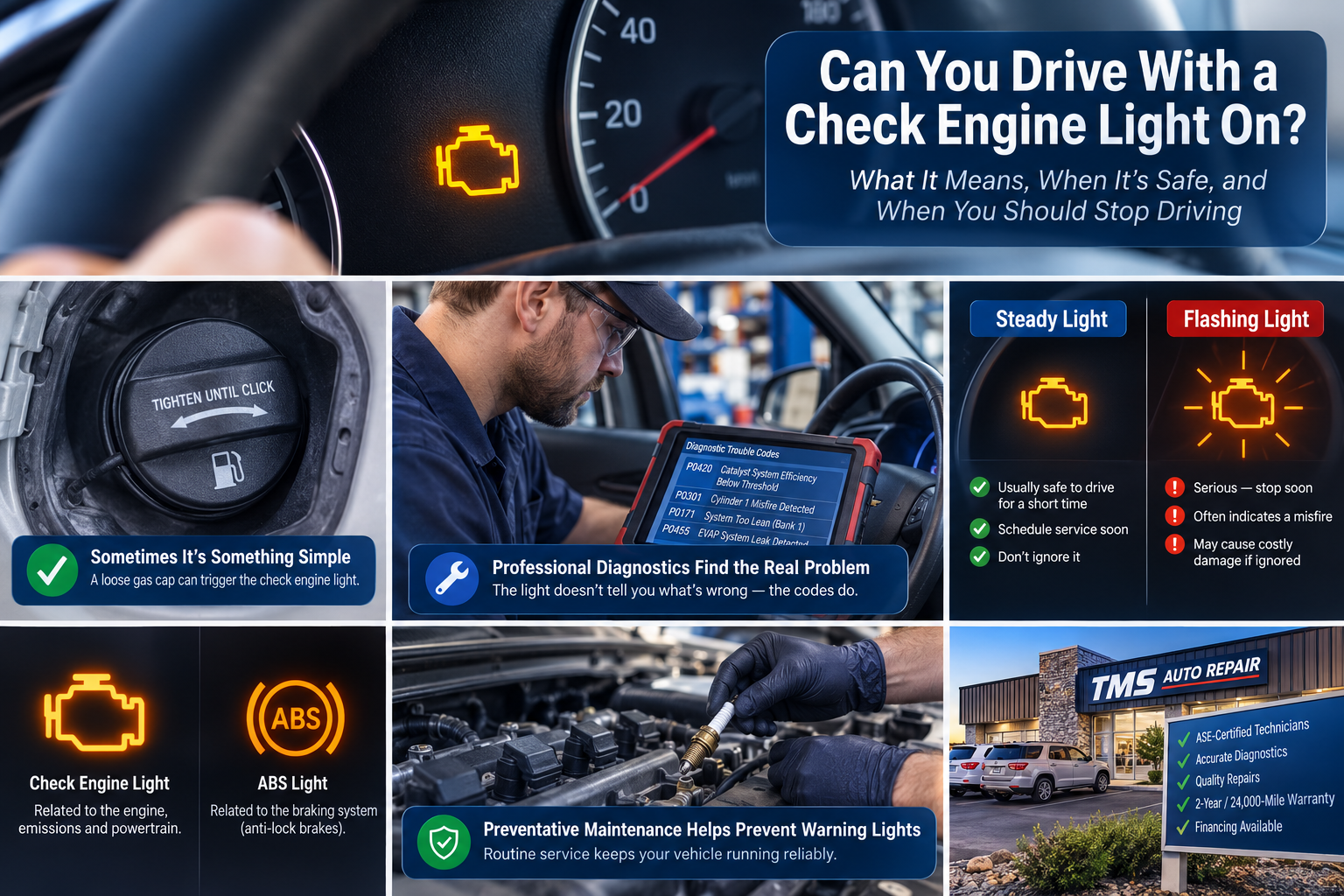
Seeing your check engine light suddenly illuminate can be unsettling. Whether you’re commuting to work, running errands, or heading out on a road trip, it’s natural to wonder if you should keep driving or pull over immediately.
The answer is: it depends.
A check engine light can be triggered by something relatively minor, like a loose gas cap, or it can indicate a serious engine problem that requires immediate attention. While not every warning means your vehicle is about to break down, every check engine light deserves prompt attention. Ignoring it can allow a small issue to develop into a much more expensive repair.
If your vehicle has a check engine light on, the experienced technicians at TMS Auto Repair can diagnose the problem accurately and recommend the appropriate repair before additional damage occurs.
What Does the Check Engine Light Mean?
Modern vehicles are equipped with an On-Board Diagnostics (OBD-II) system that continuously monitors engine performance, fuel delivery, emissions components, ignition timing, transmission operation, and dozens of other vehicle systems.
Whenever the vehicle’s computer detects a problem that falls outside normal operating parameters, it stores a Diagnostic Trouble Code (DTC) and illuminates the check engine light.
The important thing to understand is that the light itself does not tell you what failed. It simply indicates that the computer has detected a fault somewhere within one of the monitored systems.
Some of the most common causes include:
- A loose, damaged, or missing gas cap
- Faulty oxygen (O2) sensors
- Worn spark plugs
- Failed ignition coils
- Engine misfires
- Mass airflow (MAF) sensor failures
- Catalytic converter problems
- EVAP system leaks
- Fuel injector or fuel pressure issues
- Vacuum leaks
- Faulty thermostats
- Electrical wiring or sensor failures
Because hundreds of different diagnostic trouble codes can trigger the same warning light, replacing parts based on guesswork often leads to unnecessary repairs. Proper diagnostics identify the underlying problem before any repairs begin.
Why You Shouldn’t Ignore the Warning
Many drivers continue driving for weeks—or even months—with the check engine light on because the vehicle “seems fine.”
Unfortunately, that approach can become expensive.
For example, a failing ignition coil may initially cause only an occasional misfire. Left unrepaired, that same misfire can overheat the catalytic converter, damage internal engine components, reduce fuel economy, and eventually leave you stranded.
Likewise, a faulty oxygen sensor may not noticeably affect drivability at first, but it can cause the engine to run rich, increasing fuel consumption while shortening the life of emissions components.
Catching these issues early is almost always less expensive than waiting until additional components fail.
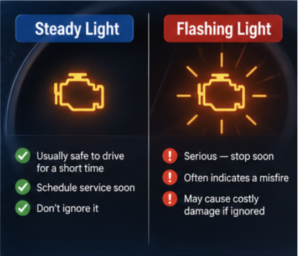
Steady Check Engine Light vs. Flashing Check Engine Light
One of the first things you should determine is whether the light is steady or flashing.
Steady Check Engine Light
A steady check engine light generally indicates a fault that should be diagnosed soon but does not necessarily require you to stop driving immediately.
In many cases, it is reasonable to continue driving if all of the following are true:
- The engine runs smoothly.
- There is no noticeable loss of power.
- Engine temperature remains normal.
- No smoke is coming from the exhaust.
- There are no unusual noises.
- No other warning lights are illuminated.
Even if the vehicle appears to be operating normally, you should schedule a diagnostic inspection as soon as possible. Some problems worsen gradually, and early diagnosis often prevents much larger repair bills.
Flashing Check Engine Light
A flashing check engine light should always be treated as urgent.
In most vehicles, a flashing light indicates an active engine misfire. When a cylinder misfires, unburned fuel enters the exhaust system, where it can quickly overheat and damage the catalytic converter.
Catalytic converters can cost thousands of dollars to replace on some vehicles, making immediate action especially important.
If your check engine light begins flashing:
- Reduce your speed.
- Avoid heavy acceleration.
- Pull over safely when possible.
- Arrange for the vehicle to be inspected or towed.
Continuing to drive under these conditions significantly increases the risk of costly engine and exhaust system damage.
Can You Continue Driving?
Whether you can safely continue driving depends on both the warning light and how the vehicle is behaving.
You may be able to drive a short distance if:
- The light is steady.
- The vehicle accelerates normally.
- The engine is not overheating.
- There are no abnormal vibrations.
- You don’t hear knocking, rattling, or grinding.
- There are no fuel smells or excessive exhaust smoke.
Even under these conditions, you should arrange service promptly.
You should stop driving immediately if you notice:
- A flashing check engine light
- Severe shaking or vibration
- Significant loss of engine power
- Engine overheating
- Thick white, blue, or black exhaust smoke
- Loud knocking or metallic noises
- Strong fuel odors
- Low oil pressure warnings
These symptoms often indicate conditions that can cause severe engine damage within a short period of time.
Many auto parts stores can retrieve diagnostic trouble codes for free, but it’s important to understand that a code is not the same as a diagnosis.
For example, a code indicating a lean fuel mixture does not automatically mean you need a new oxygen sensor. The root cause could be a vacuum leak, weak fuel pump, clogged injector, failing mass airflow sensor, or another issue entirely.
Professional diagnostics involve much more than reading stored codes.
Experienced technicians analyze:
- Live sensor data
- Fuel trim information
- Freeze-frame data
- Electrical signals
- Component operation
- Manufacturer service information
- Physical inspection results
This process allows technicians to identify the actual cause of the warning rather than replacing parts based on assumptions.
At TMS Auto Repair, ASE-certified technicians use professional-grade diagnostic equipment to pinpoint problems accurately the first time. This saves customers money by avoiding unnecessary repairs while ensuring the real issue is corrected.
Common Repairs After a Check Engine Light Comes On
Depending on the diagnostic results, repairs may include:
- Replacing worn spark plugs
- Installing new ignition coils
- Repairing vacuum leaks
- Replacing oxygen sensors
- Fuel injector service
- Mass airflow sensor replacement
- EVAP system repairs
- Catalytic converter replacement
- Thermostat replacement
- Electrical wiring repairs
Every repair begins with confirming the root cause—not simply replacing the component named in a trouble code.
Preventative Maintenance Helps Reduce Check Engine Lights
Many warning lights are preventable.
Routine maintenance allows technicians to identify worn components before they begin affecting engine performance or emissions.
Regular maintenance should include:
- Oil changes
- Air filter replacement
- Spark plug replacement at manufacturer-recommended intervals
- Fuel system inspections
- Battery testing
- Cooling system inspections
- Fluid checks
- Belt and hose inspections
These routine services also provide an opportunity to identify developing steering, suspension, brake, or tire issues before they become larger repairs.
Preventative maintenance almost always costs less than waiting for a breakdown.
Don’t Delay Repairs Because of Cost
Unexpected vehicle repairs can put a strain on any household budget. Unfortunately, delaying repairs often makes the problem worse, resulting in higher repair costs later.
If your diagnostic inspection reveals a more significant repair, TMS Auto Repair offers financing options for qualified customers, making it easier to complete necessary repairs without postponing service. Addressing problems early can prevent additional component failures, improve vehicle reliability, and often reduce the total cost of ownership over the long term.
If you’re concerned about repair costs, ask our team about available financing options during your visit.
Why Choose TMS Auto Repair?
Drivers throughout the Kansas City area trust TMS Auto Repair because we believe in accurate diagnostics, honest recommendations, and quality workmanship.
For more than 20 years, our ASE-certified technicians have repaired domestic and import vehicles using professional diagnostic equipment and quality replacement parts. Whether the problem is a simple sensor replacement or a more complex engine issue, we’ll explain what we found, why it happened, and the best repair options available.
Our goal isn’t simply to turn off the warning light—it’s to solve the underlying problem so you can drive with confidence.
The Bottom Line
So, can you drive with a check engine light on?
Sometimes—but never without understanding why it’s on.
A steady check engine light often allows you to continue driving cautiously while scheduling service. A flashing check engine light, however, should always be treated as a serious warning that requires immediate attention.
The sooner a problem is diagnosed, the better your chances of preventing additional damage and avoiding unnecessary repair costs.
If your check engine light has come on, don’t wait for the problem to get worse. Schedule a diagnostic inspection with TMS Auto Repair. Our experienced technicians can identify the cause, explain your repair options, and help keep your vehicle running safely and reliably for years to come.