
Why Does a Car Stall While Driving or Idling? Common Causes Explained
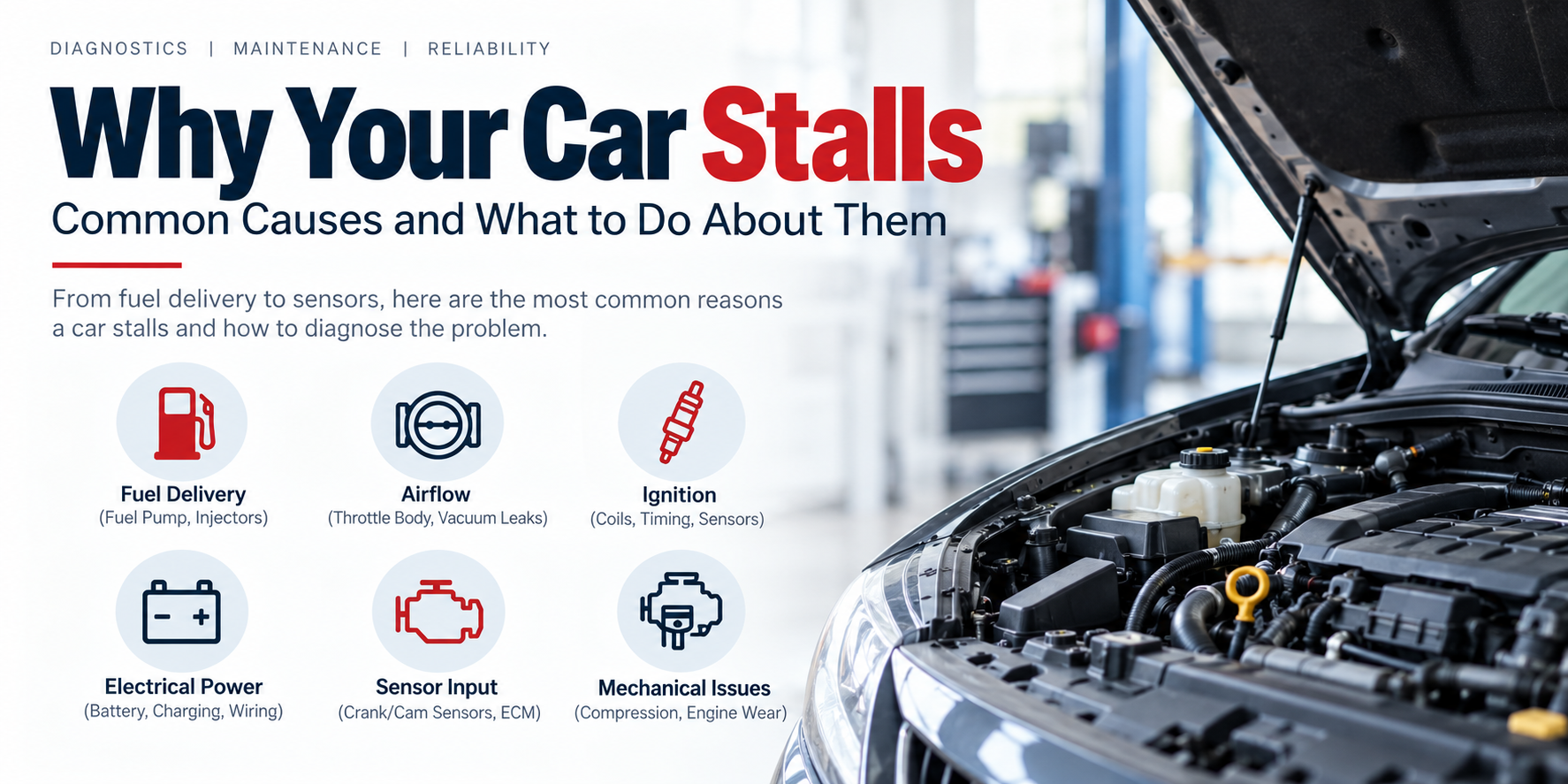
A car stalls when the engine can no longer maintain combustion. In most cases, the cause involves fuel delivery, airflow, ignition, electrical power, sensor input, or a mechanical problem with the engine.
Where and how the engine stalls provides useful diagnostic information. A car that dies only when coming to a stop often has an idle-control, airflow, or transmission-related problem. A car that suddenly shuts off at highway speed is more likely to have lost fuel pressure, ignition timing information, or electrical power.
Because many of these failures produce similar symptoms, professional automotive diagnostics are usually more effective than replacing parts based on symptoms alone.
What Makes an Engine Stall?
An engine stalls when it loses the fuel, air, spark, compression, or electronic control required to continue running.
A gasoline engine needs the correct air-fuel mixture, properly timed ignition, adequate compression, and functioning engine controls. Interrupting any one of these can cause the revolutions per minute (RPM) to fall below the point at which the engine can sustain itself.
The way the engine stops also matters. An engine that sputters, hesitates, and gradually dies often points toward fuel or airflow problems. An engine that shuts off almost instantly, as though the ignition were turned off, can indicate an electrical problem or a loss of a critical crankshaft position signal.
1. Low Fuel Pressure or a Failing Fuel Pump
A weak fuel pump can cause hesitation, loss of power, and stalling because the engine is no longer receiving enough fuel at the required pressure.
The fuel pump must maintain adequate pressure and flow as engine demand changes. A failing pump may work at idle but struggle during acceleration, or it may stop operating intermittently as it heats up.
Common symptoms include hesitation, weak acceleration, extended cranking, intermittent stalls, or an engine that restarts after sitting for several minutes.
Fuel-pressure testing can distinguish a failing pump from injector, regulator, electrical, or other fuel-system problems.
2. Fuel Injector Problems
Restricted or malfunctioning fuel injectors can cause rough idle, misfires, hesitation, and—in severe cases—stalling.
Fuel injectors must deliver precise amounts of fuel into each cylinder. Deposits, electrical faults, or pressure problems can disrupt that delivery.
A vehicle with injector problems may also have poor fuel economy, difficult starting, sluggish acceleration, or a check engine light.
TMS Auto provides fuel injection service in Kansas City for rough idle, hesitation, fuel delivery issues, throttle body deposits, and related drivability problems.
3. Crankshaft or Camshaft Position Sensor Failure
A failed crankshaft-position sensor can abruptly shut an engine off because the computer may lose the timing information required to control spark and fuel injection.
The crankshaft and camshaft sensors tell the engine control module where the rotating engine components are positioned. If the signal disappears, some vehicles can no longer correctly trigger ignition or fuel injection.
A heat-sensitive crankshaft sensor may cause particularly confusing symptoms: the engine stalls after warming up, refuses to restart immediately, and then starts normally after cooling down.
Diagnostic trouble codes and live sensor data can help identify these failures through professional car diagnostic testing.
4. Dirty Throttle Body or Idle-Control Problems
If a car runs normally while moving but stalls when you release the accelerator, insufficient airflow at idle is one possible cause.
When your foot comes off the accelerator, the engine still needs a small amount of precisely controlled airflow to remain running.
Carbon buildup around an electronic throttle plate can interfere with that airflow. Older vehicles may instead have a separate idle air control valve that can fail or become restricted.
Typical symptoms include:
- Stalling at stoplights
- RPM dropping too low while stopping
- Rough or surging idle
- Starting and then immediately dying
- Staying running only when the accelerator is pressed
Throttle body inspection and cleaning may be part of a broader fuel injection and intake service.
5. Vacuum Leaks
A large vacuum leak can make the air-fuel mixture too lean to maintain a stable idle.
A vacuum leak allows air to enter the engine without being properly accounted for by the engine-management system.
Leaks can develop around intake gaskets, vacuum hoses, PCV components, brake-booster lines, and other intake connections.
Small leaks may cause a high or uneven idle. Larger leaks can produce hesitation, lean-mixture trouble codes, rough running, or stalling, especially at idle.
Smoke testing and fuel-trim analysis are commonly used to locate leaks that are difficult to see.
6. Mass Airflow or Other Sensor Problems
Incorrect airflow or pressure data can cause stalling if the engine computer calculates the wrong amount of fuel.
The mass airflow sensor, manifold pressure sensor, throttle-position sensor, coolant-temperature sensor, and other sensors help the engine computer determine fuel delivery and ignition strategy.
A sensor does not always have to fail completely. Incorrect or intermittent readings can cause drivability problems while still appearing plausible enough for the computer to continue operating on bad information.
That is why a diagnostic trouble code does not automatically prove that the component named in the code is defective. Proper engine diagnostics compare codes with live operating data and component testing.
7. Worn Spark Plugs or Failing Ignition Coils
Severe ignition misfires can make an engine run so poorly that it cannot maintain idle speed.
Spark plugs and ignition coils ignite the air-fuel mixture inside gasoline engines. A weak coil, worn plug, damaged wiring, or ignition-control failure can cause one or more cylinders to stop contributing to normal operation.
A minor single-cylinder misfire generally causes rough running rather than an immediate stall. Multiple severe misfires, however, can cause the engine to shake, lose power, or shut down.
A flashing check engine light commonly indicates a severe misfire and should not be ignored, as unburned fuel can damage the catalytic converter.
TMS Auto’s engine repair services include ignition system, spark plug, misfire, sensor, and engine performance diagnostics.
8. Alternator or Charging-System Failure
A failed alternator can eventually stall a running car after battery voltage falls too low to operate the engine management, ignition, and fuel systems.
Once an engine is running, the alternator normally supplies electrical power and keeps the battery charged.
If the alternator output disappears, the vehicle may continue running temporarily from battery energy alone. As voltage drops, electronic modules, ignition coils, fuel pumps, and other components may stop operating properly until the engine shuts off.
Possible warning signs include a battery warning light, dimming lights, erratic electronics, repeated dead batteries, or difficulty restarting after the stall.
TMS Auto provides vehicle electrical diagnostics and repair for charging systems, batteries, wiring, and other electrical faults.
9. Loose Connections, Relays, or Wiring Faults
An intermittent loss of electrical power can shut an engine off instantly, even when the engine itself is mechanically healthy.
Loose battery terminals, poor grounds, damaged wiring, failing relays, ignition-switch problems, or electrical connections that open when hot can interrupt power to critical systems.
These problems can be difficult to reproduce because vibration, heat, moisture, or vehicle movement may determine when the connection fails.
If the engine and several dashboard or electrical systems shut down simultaneously, an electrical problem becomes particularly important to investigate.
10. EGR Valve Stuck Open
An EGR valve stuck open can cause a severe rough idle or stalling by allowing excessive exhaust gas into the engine at low RPM.
The exhaust gas recirculation system intentionally introduces a controlled amount of exhaust gas under certain operating conditions.
At idle, however, excessive EGR flow can destabilize combustion. A stuck-open valve may therefore cause an engine to run acceptably at higher RPM but stumble or die when the vehicle stops.
11. Torque Converter Clutch Problems
If an automatic car stalls almost exclusively when stopping, a torque converter clutch that remains locked can stall the engine, much like stopping a manual car without pressing the clutch.
The torque converter allows an automatic-transmission vehicle to remain stopped while the engine continues running.
Many vehicles lock the converter during cruising for greater efficiency. That lockup must release as the vehicle slows.
If it remains engaged, the transmission can mechanically drag the engine RPM down until the engine stalls.
This is one reason a vehicle that consistently dies exactly as it comes to a stop may require diagnosis beyond the engine itself.
12. Engine Overheating
Severe overheating can cause poor running or engine shutdown and can quickly lead to major internal engine damage.
Overheating may result from low coolant levels, coolant leaks, thermostat failure, a defective water pump, radiator obstructions, or cooling fan problems.
If the temperature gauge enters the hot range or an overheating warning appears, continuing to drive can damage the head gasket, cylinder head, pistons, bearings, and other engine components.
TMS Auto provides cooling system repair in Kansas City for overheating, coolant leaks, radiators, thermostats, water pumps, and cooling-system diagnostics.
Why a Car Stalls at Idle but Runs While Driving
Stalling primarily at idle usually points to an airflow, mixture control, ignition, EGR, or torque converter problem that becomes most noticeable at low RPM.
An engine may appear normal at 2,000 RPM but fail to sustain itself around its normal 600-800 RPM idle range.
Common causes include throttle body deposits, vacuum leaks, weak ignition components, incorrect airflow readings, fuel delivery problems, EGR faults, or a torque converter clutch that remains engaged.
The accelerator can temporarily mask some of these problems by increasing airflow and engine speed.
Why a Car Stalls While Driving
Stalling while cruising is more concerning for fuel pressure loss, crankshaft sensor failure, ignition loss, or electrical power failure.
Pay attention to what happens immediately before the stall.
A gradual loss of power or sputtering may suggest inadequate fuel delivery. An abrupt shutdown with little warning may point toward problems with the crankshaft sensor, ignition, or electrical system.
Whether the vehicle restarts immediately or only after several minutes is also diagnostically useful.
Why a Car Stalls When Stopping at a Red Light
A car that repeatedly dies only when slowing to a stop often cannot maintain idle speed once the throttle closes.
Common causes include a dirty throttle body, vacuum leak, EGR problem, fuel injection issue, ignition problem, or a torque converter clutch that does not disengage.
The fact that the car runs normally with the accelerator pressed does not rule out an engine problem. Higher RPMs can conceal problems that become obvious only at idle.
Can a Bad Battery Cause a Car to Stall While Driving?
A weak battery alone usually does not stall a normally running vehicle, but charging-system failure or a bad electrical connection can.
The alternator normally powers the vehicle once the engine is running.
However, a failed alternator can force the vehicle to run on the battery until voltage drops too low to sustain the engine. A loose battery terminal, internal battery fault, or major connection problem can also interrupt power.
Battery and charging system testing should therefore be performed together when a vehicle exhibits both stalling and repeated battery problems.
Can Low Oil Cause a Car to Stall?
Being moderately low on oil normally does not directly cause stalling, but critically low oil pressure can destroy or seize an engine.
If an oil-pressure warning appears before the engine stalls, shut the engine off as soon as safely possible.
However, the oil pressure and battery lights commonly illuminate after an engine has already stalled. Once the engine stops rotating, oil pressure and alternator output disappear naturally. Those warning lights appearing after the stall, therefore, do not prove that low oil or the battery caused it.
Is It Safe to Drive a Car That Keeps Stalling?
No. Repeated engine stalling poses a safety risk because propulsion is lost or braking assistance may be reduced.
The steering system remains steerable, but steering effort can increase significantly on vehicles that lose power assist. Brake assist may also become limited after the engine stops, depending on the vehicle’s system.
A car that repeatedly stalls, loses power at highway speed, overheats, or displays an oil-pressure warning should be diagnosed before normal driving continues.
What to Do If the Engine Stalls While Driving
Maintain control, activate the hazard lights, and move out of traffic if possible.
Do not panic if the steering suddenly feels heavier or the brake pedal requires additional effort. Concentrate on bringing the vehicle safely to the side of the road.
Do not repeatedly restart an engine that was severely overheating, making major mechanical noises, or displaying an oil-pressure warning immediately before shutting down.
Even if the engine restarts normally, intermittent failures such as crankshaft sensors, fuel pumps, relays, and electrical connections can recur without warning.
How a Stalling Problem Is Diagnosed
Accurate stall diagnosis requires identifying which input disappeared—fuel, spark, airflow control, electrical power, sensor synchronization, or mechanical operation.
Diagnosis may include checking stored and pending trouble codes, examining live sensor data, measuring fuel pressure, testing ignition output, checking battery and alternator voltage, inspecting fuel trims, smoke-testing the intake system, or performing compression and mechanical engine tests.
Trouble codes are starting points rather than diagnoses. The objective is to determine why the engine stopped running, not simply replace whichever component appears in a code description.
Car Stalling Diagnosis in Kansas City, MO
If your car dies at stoplights, stalls while idling, loses power during acceleration, or shuts off unexpectedly while driving, TMS Auto Repair can diagnose the underlying problem.
TMS Auto provides automotive diagnostics, engine repair, fuel injection service, electrical repair, and cooling system service in Kansas City, MO.
Finding the cause early can turn an intermittent stalling problem into a targeted repair instead of an unexpected roadside breakdown.
Frequently Asked Questions
What is the most common reason a car stalls at idle?
Airflow and mixture-control problems are common causes, including throttle-body deposits, vacuum leaks, fuel-delivery problems, EGR faults, and sensor problems. Ignition and transmission-related faults can produce similar symptoms.
Why does my car shut off while driving and then start again?
Intermittent crankshaft position sensors, fuel pumps, relays, electrical connections, or ignition components can temporarily fail and then resume working. Heat-related electrical failures are especially known for this pattern.
Can bad spark plugs cause a car to stall?
Yes, although one weak spark plug normally causes a misfire rather than a complete stall. Severe or multiple ignition misfires can cause the engine to lose idle speed.
Can a bad alternator make a car shut off?
Yes. Once the alternator output is lost, the vehicle can operate temporarily from the battery. The engine can shut off when the battery voltage falls below the level required by the ignition, fuel, and engine management systems.
Can a bad fuel pump cause intermittent stalling?
Yes. A weak or heat-sensitive fuel pump may intermittently lose pressure, causing hesitation, loss of power, stalling, or difficulty restarting.
Why does my car stall only when I come to a stop?
If the vehicle stalls only when engine speed drops to idle, possible causes include insufficient throttle airflow, a vacuum leak, EGR malfunction, weak ignition, fuel delivery problems, or an automatic transmission torque converter clutch that remains locked.
Should I keep driving after my car stalls once?
An isolated stall still deserves attention, particularly if the cause is unknown. If stalling repeats or occurs while the vehicle is moving, diagnostic testing should be performed because the next loss of engine power could occur in traffic.